Powered by an index of 100M+ scholarly works
Watch less.Understand more.
Drop in a YouTube link, an article, a podcast or a PDF. You'll get back a summary that takes a minute to read and a fact-check that tests its claims against scientific research.
Free plan · No credit card · 12 languages
An 18 minute 44 second video, read in about a minute. Claims from the published check are marked on the timeline at the moment they are said.
Vitamin D functions as a crucial hormone affecting nearly every tissue and organ system in the human body.
- Vitamin D influences brain function, sleep cycles, mood stability and cognitive health.
- It acts as a potent anti-inflammatory agent supporting immune health and skeletal development.
- 01:50
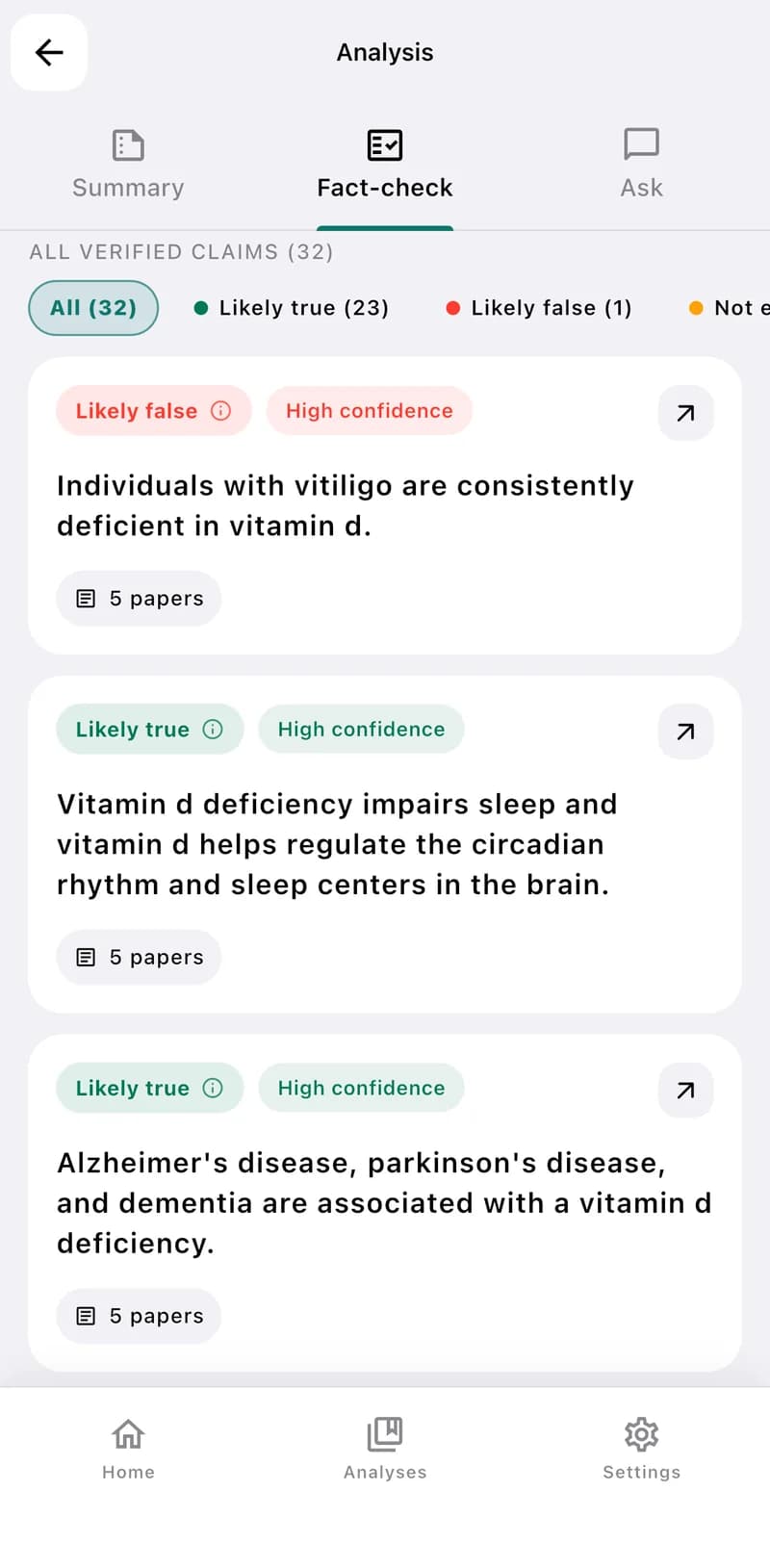
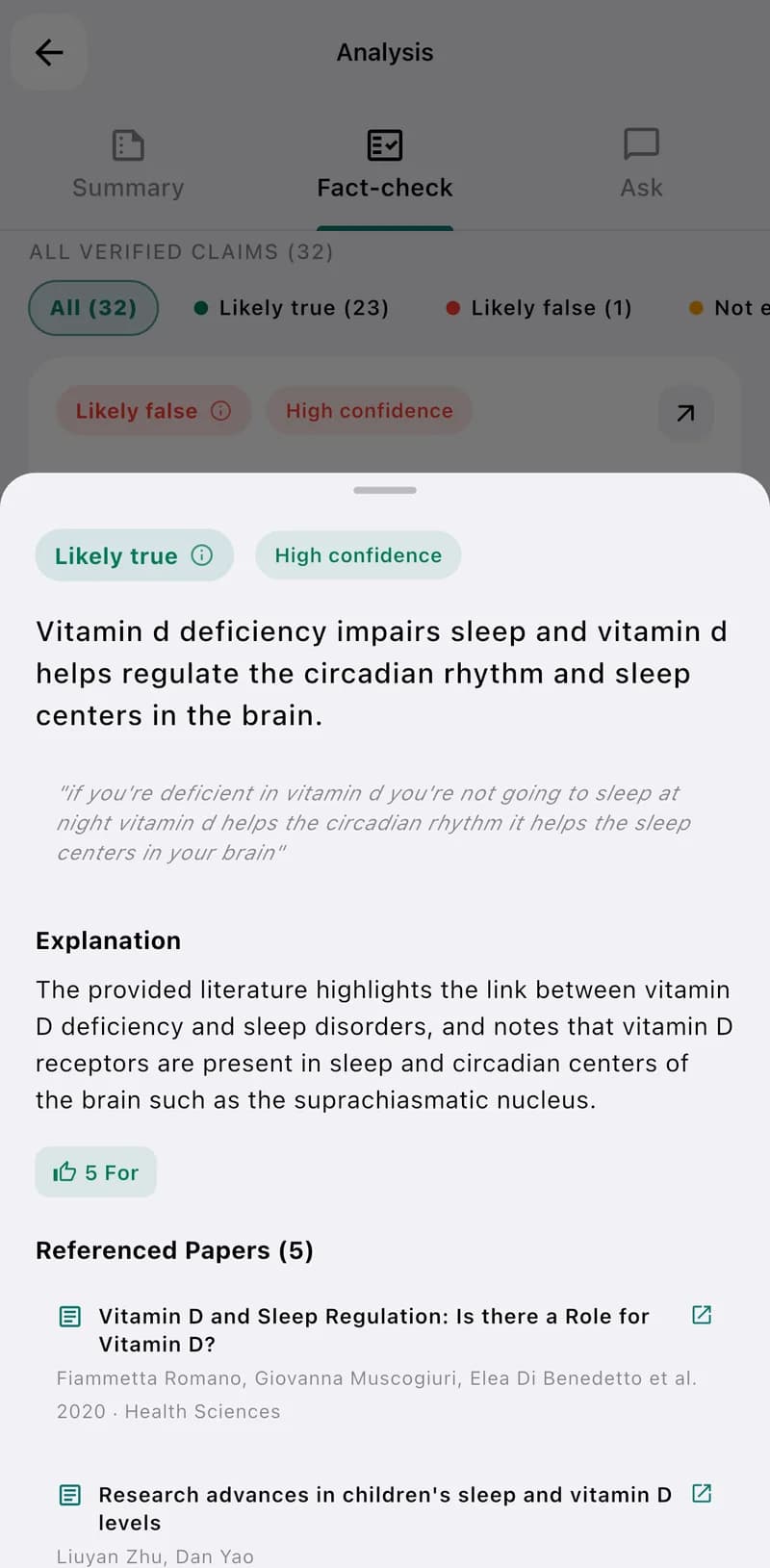
Vitamin D deficiency impairs sleep, and vitamin D helps regulate the circadian rhythm and sleep centers in the brain.
Supported by research5 papers - 02:22
Alzheimer's disease, Parkinson's disease and dementia are associated with vitamin D deficiency.
Supported by research5 papers People with vitiligo are consistently deficient in vitamin D.
Not confirmed5 papers
This is a genuine analysis, not a mock-up.See the published check

Everyone has something to say. Who do you trust?
Information has never been easier to find, yet it has never been harder to separate fact from opinion. EvidenceLens gives you a calm, evidence-based second opinion within seconds.
Know more. Get manipulated less.
Four simple things, for every claim you come across.
Know what the research says
Find out which claims are actually supported by real studies.
Protect yourself from manipulation
Catch confident claims that have no evidence behind them.
Understand the context
See the limits and caveats that come with each claim.
Check the sources
Read the research the conclusions are based on.
Paste a link. We do the rest.
It couldn't be simpler.
- 1
Paste a link
A video, article, podcast or PDF — anything you want to check.
- 2
We analyze it
EvidenceLens reads the content and picks out the claims that matter.
- 3
You get clear conclusions
Each claim gets a plain-language verdict, together with the sources behind it.
See what is actually known.
Each claim gets a clear, color-coded verdict, and you can open the studies behind that verdict.
Research supports 23 of the 32 claims in this video, while one is not confirmed. The remaining 8 can't be judged yet because there isn't enough research on them.
Supported by research
Supported by strong, consistent scientific evidence.
Treat with caution
Some support, but with important limits or mixed results.
Not confirmed
The evidence does not support this claim.
Not enough data
There isn't enough research yet to judge it.
Every verdict links to the publications it rests on.
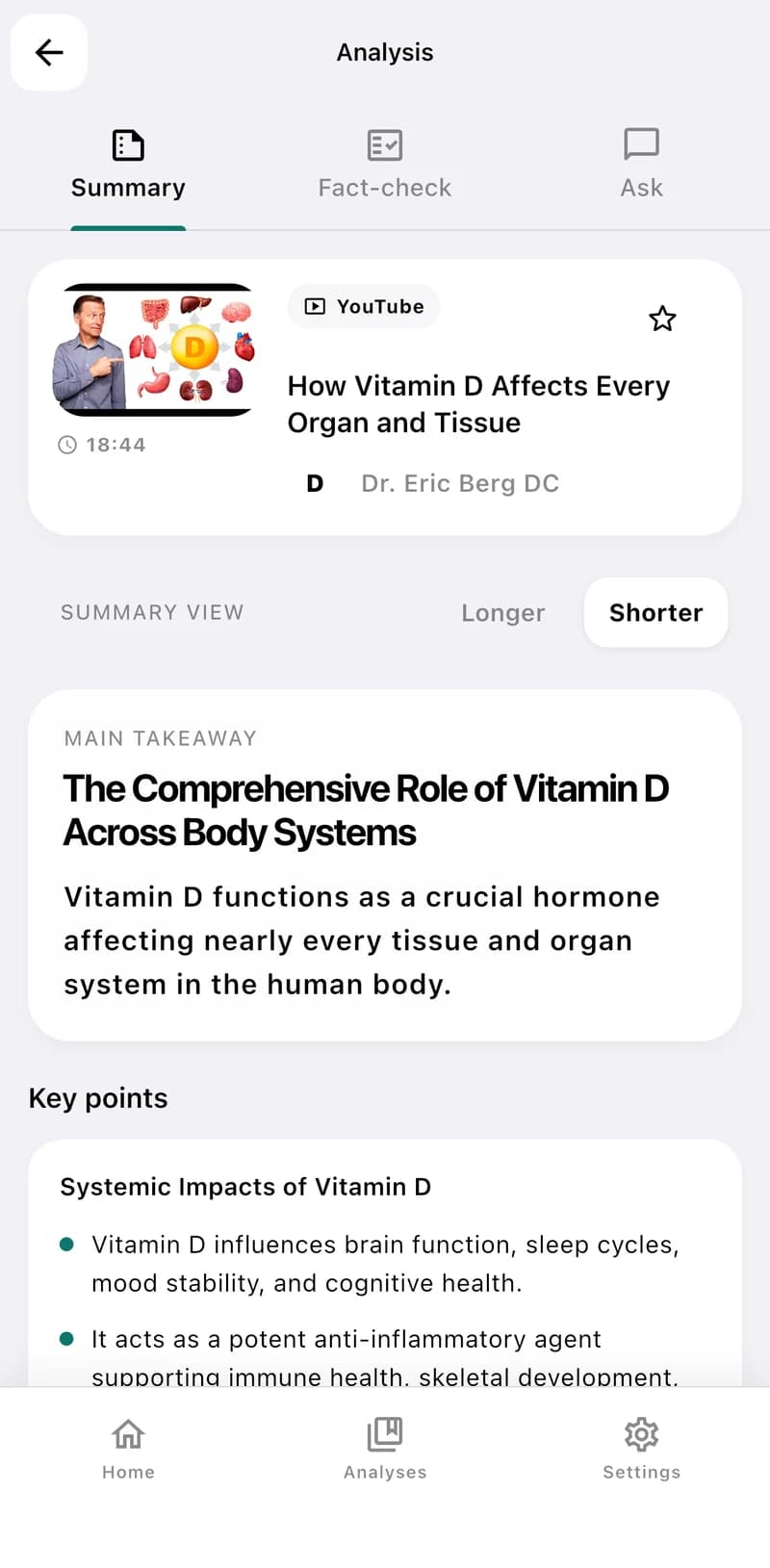
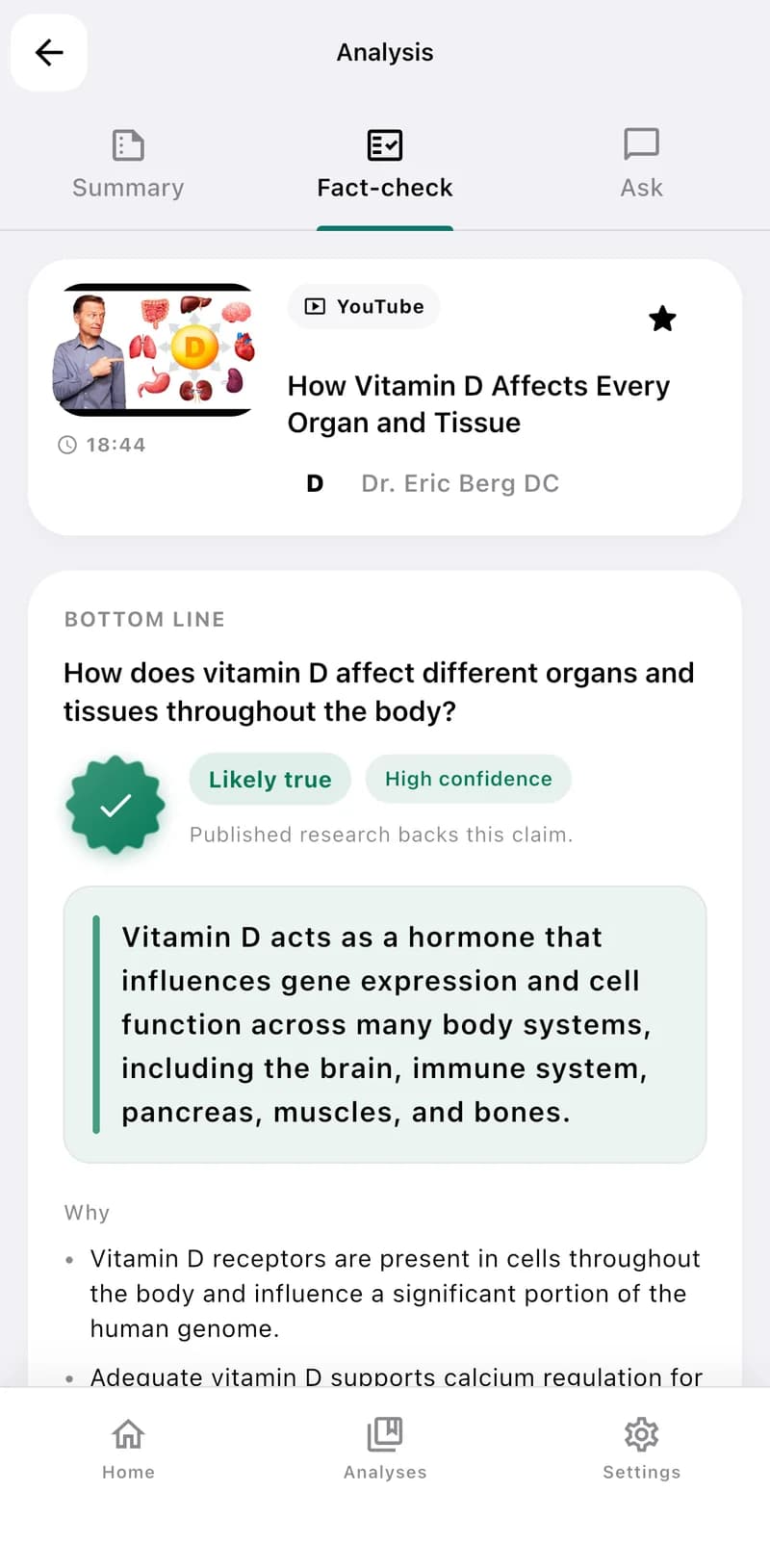
A long video you can read in about a minute.
This is how it looks
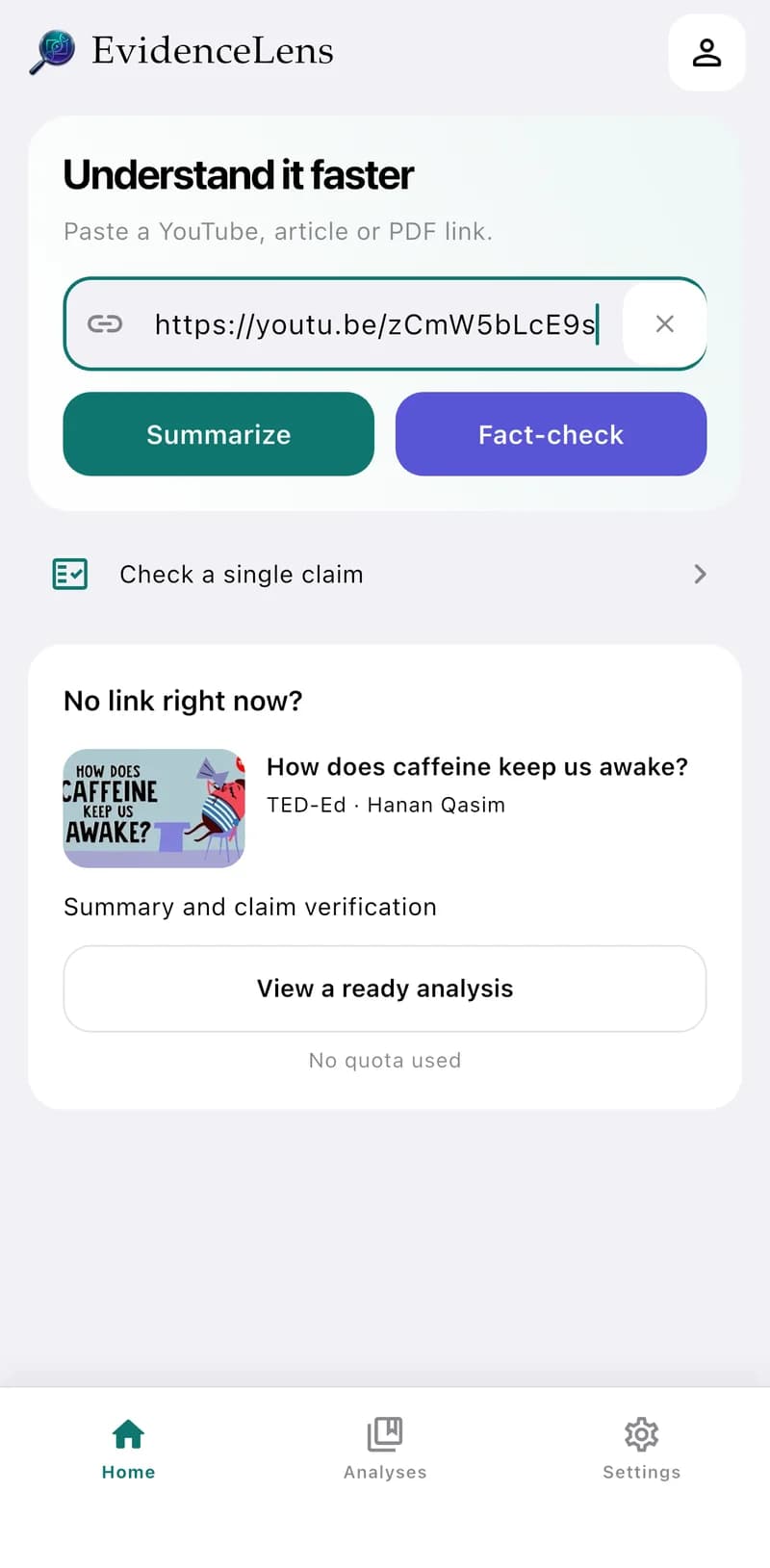
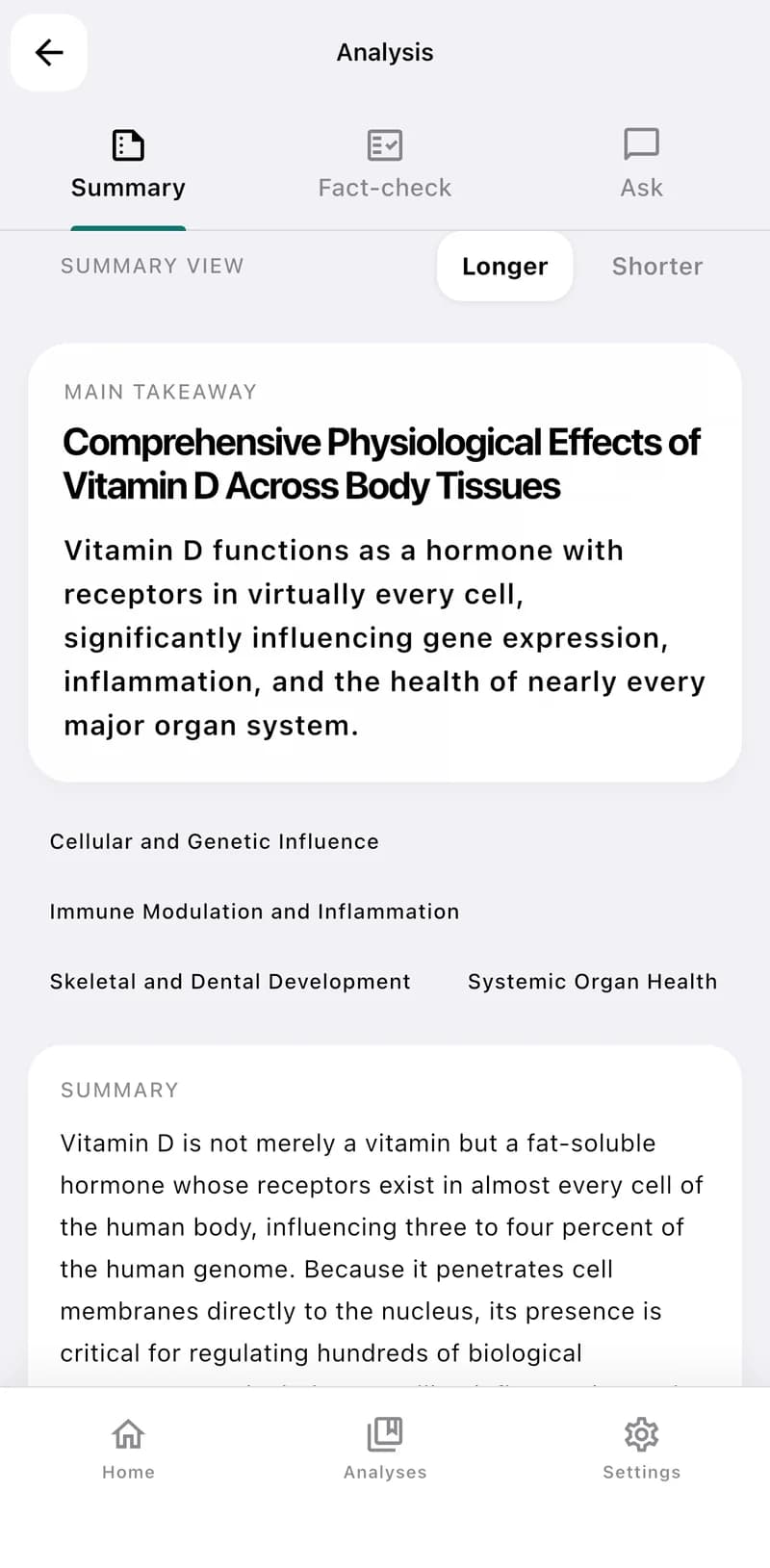
Share this analysis
Share a useful result along with the evidence behind it.
Anyone with the link can see the results you selected, but your chat and the full source text stay private.
It opens in any browser, with no account or app required.
Real checks, published for everyone.
We take claims from popular videos, check them against scientific research, and publish each one with its sources. Open any claim to read the studies for yourself.
- Not confirmed
Does intermittent fasting work better than ordinary dieting?
No, intermittent fasting does not lead to greater weight loss than continuous calorie restriction.
5 papers - Supported by research
Does multitasking make you less productive?
Yes, multitasking consistently reduces productivity and task performance due to negative cognitive outcomes and dual-task costs.
5 papers - Supported by research
Are electric cars really better for the climate?
Yes, electric vehicles generally result in lower total greenhouse gas emissions across their entire lifecycle compared to gasoline-powered vehicles.
5 papers
We don't tell you what to think. We show you what's worth basing your decision on.
Built on real research, not just a confident guess.
Unlike most AI tools, which answer from general training data, EvidenceLens is built around a library of over 100 million scholarly works and matches each claim in your content with the studies that test it.
- 100M+ scholarly works indexed across scientific domains
- The claims you hear, smartly matched to the studies that test them.
- Direct citations, paper metadata, and evidence confidence
- Study context and caveats for claims that are not settled
For everyone who wants to think for themselves.
Whatever you watch or read, the task stays the same: understand the point, then check it.
Students
Preparing for an exam? Summarize a two-hour lecture and verify the figures it cites.
Parents
Check health advice from a viral video before you act on it.
Doctors
If a patient raises a claim during an appointment, pull up the studies behind it.
Creators
Before publishing, fact-check your script against the research.
Teachers
Turn a documentary into a discussion sheet, with sources your students can open.
And everyone who wants to make better decisions, every day.
Add to Chrome — freeStart free. Upgrade when you want more evidence.
Every plan includes summaries, claim checks, and chat. The Lifetime launch price is a one-time payment while the offer is available.
Free
For quick checks and first-time users
- 20 verifications / month
- 50 summaries / month
- 30 chat messages / month
- Evidence taxonomy & credibility score
- Unlimited verifications — Not included
Plus
For regular YouTube research sessions
- 300 verifications / month
- Unlimited summaries
- Unlimited chat messages
- Evidence taxonomy & credibility score
- Access to 100M+ scholarly works
Plus Lifetime
Best value for long-term evidence checks
One-time payment only
- Everything in Plus
- One-time payment only (€49)
- Lifetime access while EvidenceLens is available
- Priority support
- Early access to new features
- Save €120 vs the €169 base price
- No recurring billing
All plans include access to 100M+ indexed scholarly works · Prices are in EUR · VAT may apply
Frequently asked questions
What to know before installing.
EvidenceLens, an AI video summarizer, backs its fact-checks with research. When you paste in a YouTube video, article, podcast or PDF, the tool gives you a short summary of the key takeaways. Beyond the summary, it picks out the important claims, checks each one against scholarly works, and assigns it a clear verdict linked to the sources. For YouTube, there's a Chrome extension; the mobile app covers everything else.
YouTube videos, podcasts, online articles and news, and PDF documents such as research papers or reports are all supported. As a rule, anything that makes factual or scientific claims works well.
Yes. A link isn't required. Just type or paste the claim, for example a sentence you heard in a podcast, and EvidenceLens checks it directly against the research library, returning the same verdicts and sources.
Yes. You can choose the language for summaries and fact-checks, and both the extension and the app come in 12 languages: English, Polish, German, Spanish, French, Italian, Dutch, Portuguese, Russian, Japanese, Korean and Chinese.
EvidenceLens is designed around the way you watch: it starts with a summary, extracts the claims next, and finishes with verdicts grounded in an indexed research database, complete with citations and caveats. General-purpose AI tools can help too, though they weren't built specifically with YouTube transcripts and research verification in mind.
Our own infrastructure indexes the database's more than 100 million scholarly works, which are drawn from established academic repositories. Topics range across health, psychology, environment, education, economics, technology, engineering, and social science.
Yes, and you don't need a credit card. Every month you get 20 verifications, 50 summaries, and 30 chat messages. If you need more, Plus raises that to 300 verifications and adds unlimited summaries and chat.
EvidenceLens extracts claims and uses semantic search to match them against scientific literature. Every claim gets a nuanced verdict, such as supported, refuted, overstated, or inconclusive. Confidence levels and citations come with it, so you can review the evidence yourself.
Yes. There are no contracts or commitments, so nothing locks you in. You can cancel your Plus subscription from your dashboard, and you keep access until the current billing period ends.
Your content is held temporarily in the processing queue while your request is completed. Analysis results may be cached for reuse, and they can include quotations from what you submitted. Sharing is up to you: a public result link is created only if you decide to share, and anyone with that link can view the result you selected. Disabling the link removes its public snapshot.

Don't let anyone manipulate you.Check what you watch, read and listen to.
Install EvidenceLens for free and get clear, evidence-based answers within seconds.
Free forever plan · no credit card · Browser extension and mobile app